9,000 Audiences Told Us What They Want From Memberships. Are You Listening?
Research from Indigo reveals a significant gap between what arts organisations want from membership and what audiences actually value. Here's what they found, and what you can do about it.
What is the Membership Matters report?
Published in April 2026 by Indigo, Membership Matters is one of the most comprehensive pieces of audience research on arts and cultural membership produced in the UK. Conducted across 59 cultural organisations, including theatres, arts centres, concert venues, museums and galleries, it gathered over 9,000 audience responses to understand both what organisations want from membership schemes, and what audiences actually value.
The findings are a useful reality check for anyone working in arts development, marketing or audience engagement. And the central message is clear: audiences have told us exactly what they want. But are we actually listening to what they are saying?
What 9,000 audiences told us
Audiences are already membership-savvy. People hold an average of four memberships across their lives, from streaming services and retail loyalty cards to heritage attractions and gym subscriptions. Only 2% have no memberships at all outside arts and culture, and just 1% say they would never consider an arts or cultural membership. The appetite is there.
Arts memberships are more complex than audiences want. Non-arts memberships tend to be built around one clear driver: savings (retail loyalty cards), access (streaming), support (heritage memberships), convenience (delivery subscriptions) or belonging (sports season tickets). Arts memberships, by contrast, bundle all five into a single product with multiple tiers, dozens of benefit types and an enormous variety of names, from "Lavender Member" to "Emerging Artist Benefactor." The result is a confused proposition that asks audiences to do too much mental arithmetic before they buy.
Organisations and audiences want different things from membership. Organisations overwhelmingly see membership as a tool for generating additional income (86%) and encouraging philanthropic giving (71%). Audiences, when it comes to actually buying, want savings and priority access first. Support for the organisation ranks second after the fact, as a feel-good factor once they're already members, but it rarely drives the initial decision.
The benefits being offered don't match the benefits being wanted. Organisations invest heavily in member-only events (offered by 72% of organisations, wanted by only 26% of audiences) and bespoke exclusive communications (offered by 70%, wanted by just 12%). Meanwhile, the benefits audiences most want, including no booking fees (wanted by 57%, offered by only 47%) and free or flexible ticket exchanges (wanted by 40%), are underrepresented. Free or discounted tickets and priority booking are where supply and demand are most closely aligned, but there is still meaningful room to improve.
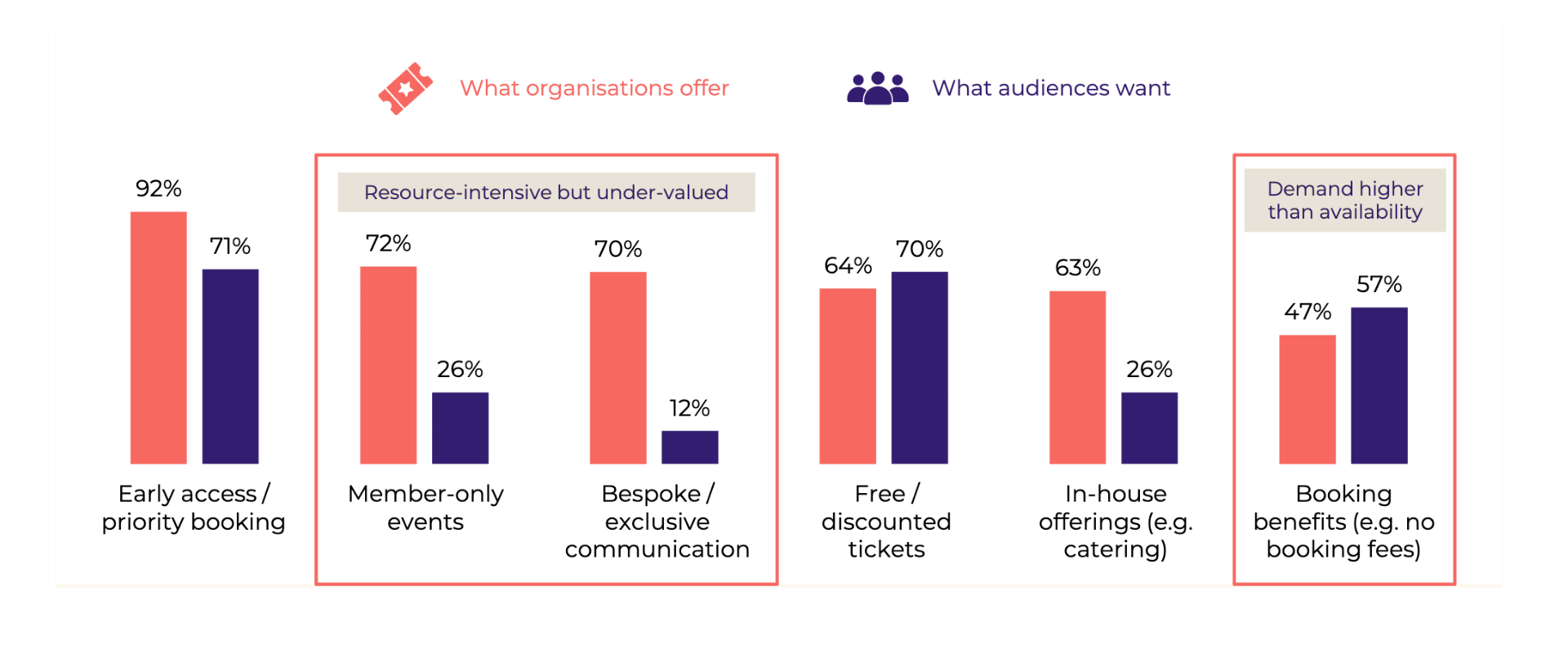
The benefits organisations offer don’t always match what audiences want. Source: Membership Matters, © Indigo Ltd, April 2026.
The biggest barriers to joining are internal, not external. Even among highly frequent arts attenders, the number one reason for not buying a membership is the worry that they won't use it enough to get value for money (cited by 49% as a past barrier, and 57% as a likely future one). Price is secondary. This means the sector's instinct to add more benefits to justify the cost may actually be making the problem worse by increasing perceived complexity.
There are three key mismatches limiting membership value:
Mismatch 1: What organisations want out of membership (income, philanthropy) versus what audiences value (savings, access).
Mismatch 2: The benefits organisations offer versus the benefits audiences most want.
Mismatch 3: Membership is framed as doing lots of jobs versus doing one job well.
The recommended fix is to separate 'Member' from 'Supporter'. Indigo's primary recommendation is to pull membership and philanthropic support apart, rather than bundling them into one product. A 'Member' scheme should be anchored in behavioural loyalty, making it easier to attend more often through priority booking, ticket flexibility and savings. A 'Supporter' scheme should focus on bringing people closer to the mission, with communications and benefits designed around giving and connection. Each can then do one job well, rather than both doing multiple jobs badly.
Three things arts organisations should do next
The good news buried in this research is that 9,000 audiences also just handed you a clear brief. Here's how to start acting on it:
1. Define the primary job your membership is doing
Before you reconfigure anything, get clear on purpose. Is your scheme primarily there to drive attendance frequency? Generate unrestricted income? Develop a pipeline of major donors? The answer determines everything else, from pricing and benefits to how you communicate the scheme on your website and at the box office.
2. Separate membership from philanthropy in how you manage and communicate it
Even if your current scheme blends the two, the way you manage contacts and communications should reflect the distinction. Members who joined for priority booking have a completely different relationship with your organisation than those who joined to support your education programme. Treating them identically in your communications and reporting is a missed opportunity on both sides.
3. Act on the data you already have
The Indigo research is sector-wide evidence. Your own CRM data tells you what is happening in your organisation specifically: which members are booking, which are lapsing, which benefits are being used and which are not. The combination of sector insight and your own operational data is where the real strategic work happens.
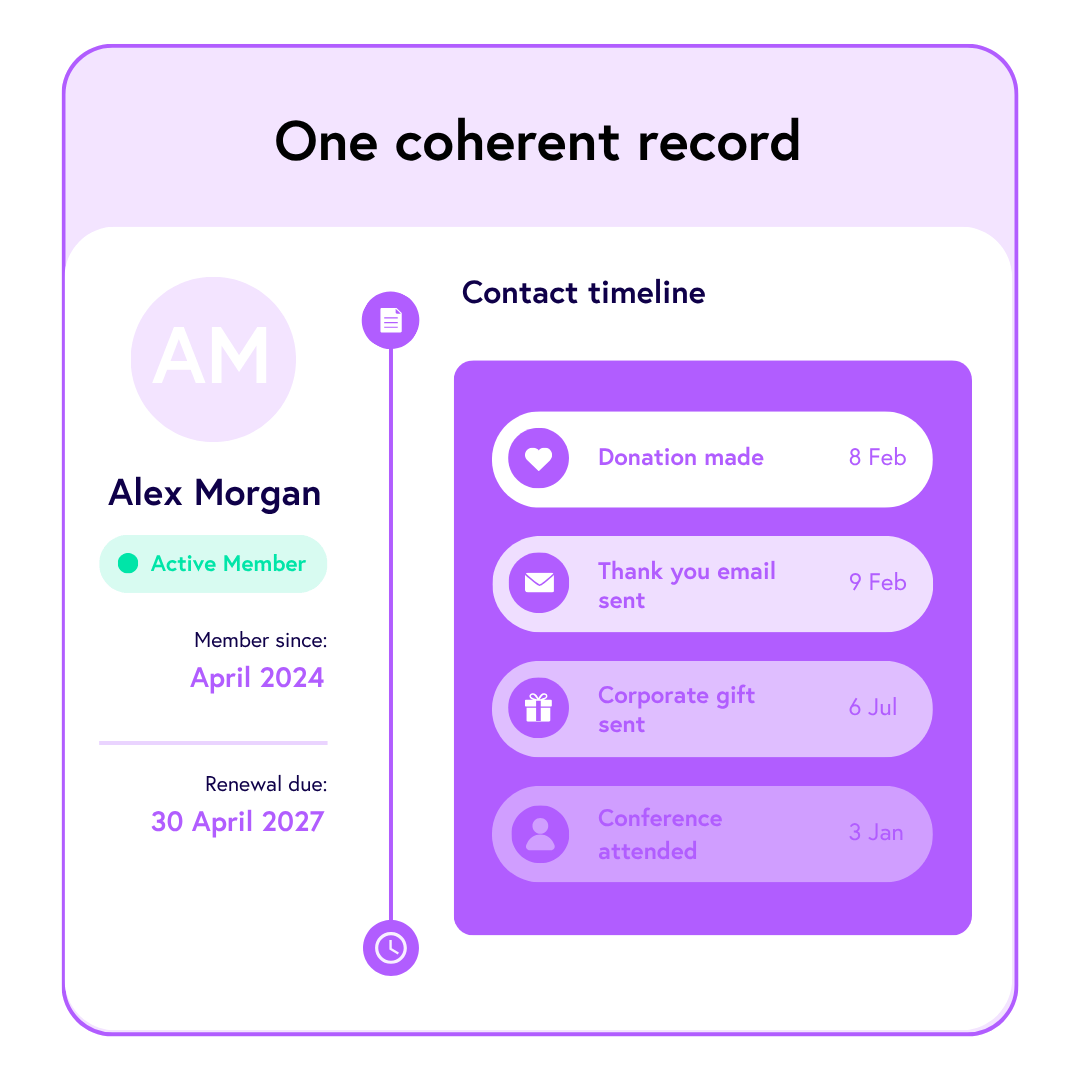
Connect membership, attendance and giving in one coherent record.
How GoodCRM can help you action this
GoodCRM is built specifically for arts, heritage and cultural organisations in the UK.
Here is how its features map directly to what those 9,000 audiences told us they want, and what the report recommends in response.
Membership module: clarity and segmentation from the start
GoodCRM's membership module lets you configure distinct scheme types with their own benefit sets, price points and renewal workflows. Rather than one overladen scheme trying to do everything, you can run a clean 'Member' tier (priority booking, no booking fees, flexible exchanges) alongside a separate 'Supporter' or 'Friend' tier focused on giving, each with distinct communication journeys and reporting.
Custom fields and forms let you capture exactly what motivated someone to join, whether that's saving money, attending more often or supporting the organisation's mission. Over time, this builds a picture of which propositions are converting, and which aren't, directly addressing the 'say-do gap' the report identifies between why people say they joined and what actually influenced their decision.
Central timeline: see the whole relationship
One of the core problems the report surfaces is that organisations lack a joined up view of whether their membership scheme is actually driving the behaviours they want. GoodCRM's central contact timeline brings together ticketing activity, membership status, giving history, email engagement and event attendance in one place.
If a member joined for priority booking but hasn't booked a single show in eight months, that shows up clearly. If a lapsed supporter has attended three events as a non-member in the same period, that is a re-engagement opportunity waiting to be acted on. The central timeline turns disconnected data into a coherent relationship history.
Automations: make the right ask at the right moment
The report notes that 62% of organisations struggle with new member recruitment and 44% with retention, yet many lack the internal resources to manage complex schemes. GoodCRM's automations reduce that administrative burden significantly.
You can configure multiple renewal reminders that trigger before expiry, with messaging tailored to each member's history, how many times they've attended, which benefits they've used, and how long they've been a member. For those who have lapsed, an automated re-engagement sequence can go out at a set interval post-expiry, framed around the specific benefits they originally joined for. For new members who haven't yet made their first booking, a welcome journey can nudge them towards using their priority booking benefit before the 'will I use it enough?' anxiety sets in.
This directly addresses what the report identifies as the single biggest barrier to both joining and renewing.
Integrations: connect membership to ticketing
The report recommends aligning membership with ticketing to drive behavioural loyalty. GoodCRM integrates with leading ticketing platforms, meaning membership status can inform the booking experience in real time. Priority booking windows, waived booking fees and flexible exchange policies can all be applied automatically based on CRM membership data, removing the friction that currently sits between a member's intention to attend and their ability to book easily.
Custom forms and surveys: close the say-do gap
GoodCRM's custom forms can be deployed at key moments in the member journey: at sign-up to capture motivation, at renewal to surface what is and isn't working, and at lapse to understand why someone didn't continue. This turns your membership programme into a continuously improving product, rather than a static scheme reviewed once every few years. In other words, you get to keep listening, long after the survey closes.
Reporting: know what your scheme is actually doing
GoodCRM's reporting tools let you measure membership performance against the outcomes that matter to your organisation, whether that's attendance frequency among members versus non-members, average giving uplift after joining, benefit utilisation rates, or renewal rate by tier. These are the metrics that tell you whether your scheme is fulfilling its stated purpose, which is the very first question the report asks you to answer.

Ready to see this in practice?
9,000 audiences have told us what they want from arts membership. Now it's time to build it. GoodCRM was designed for organisations exactly like yours, and we'd love to show you how the platform can help you action the findings from Membership Matters, whether you're reviewing an existing scheme, separating your membership and fundraising products for the first time, or building something new from the ground up.
Book a demo with the GoodCRM team or
Download our free Membership Planning Template.